

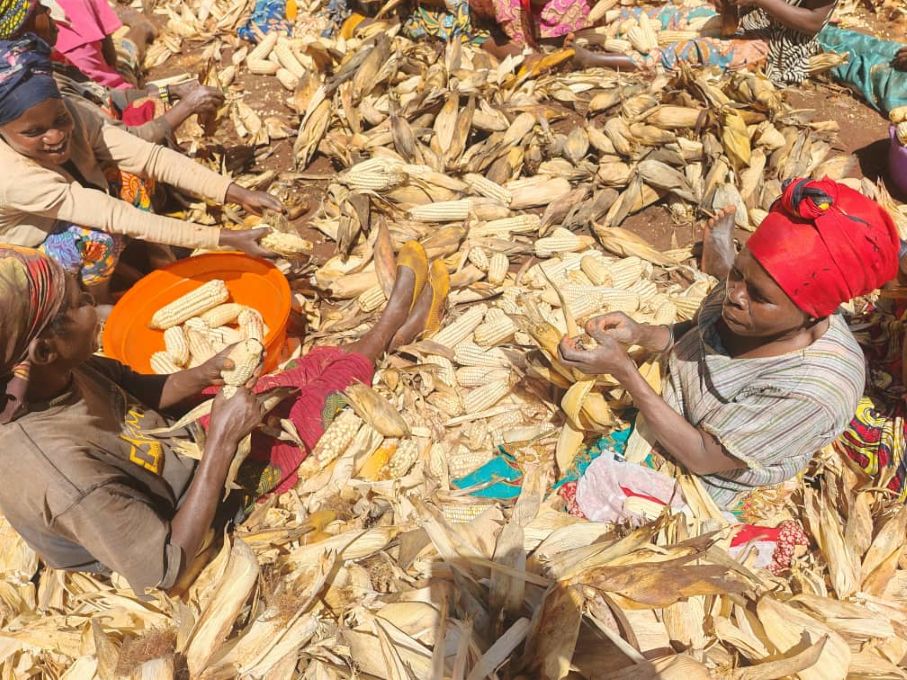
In the heart of South Kivu, Democratic Republic of Congo, the African Agricultural Leadership Institute (AALI) is helping revitalize agricultural productivity and resilience through an innovative Block Farming model. Despite persistent security challenges in Eastern DRC, this approach has enabled small-scale farmers in the Ruzizi Plains and Walungu to begin harvesting maize collectively, marking a promising milestone in inclusive agribusiness development.
Block Farming is more than a cultivation strategy—it is a community-centered framework that unites smallholders, technical partners, and value-chain actors in collaborative planning, production, and marketing. By organizing land into contiguous blocks and coordinating activities across groups of farmers, this model enhances access to critical inputs, optimizes resource use, and strengthens bargaining power in markets.
At Ferme Malago and adjacent plots across the Ruzizi region, over 400 producers participating in Block Farming have seen tangible gains in maize yields and operational efficiency. This success reflects AALI’s commitment to amplifying smallholder agency, facilitating shared access to improved seeds, mechanization, and agronomic support.
The impact of this model extends beyond harvests—it embodies a vision for inclusive agribusiness where small producers, larger agricultural partners, and technical institutions work in synergy. By strengthening production systems and streamlining value chains, block farming contributes directly to food security, economic opportunity, and rural resilience in regions often marginalized by traditional agricultural interventions.
Moreover, Block Farming underscores the role of youth and women as active drivers of agricultural transformation. As participants gain hands-on experience and collaborative leadership skills, they are better positioned to innovate, access markets, and lead community-based enterprises that generate income and enhance local food systems.
The success of Block Farming in South Kivu highlights AALI’s broader mission: to catalyze participatory agricultural solutions that are both inclusive and sustainable. By reinforcing local capacity and fostering multi-actor collaboration, this model demonstrates how strategic agricultural organization can turn vulnerability into opportunity and empower rural communities across Africa.